11–15 July 2026 – Vancouver, Canada
Before a treatment reaches a patient, researchers need to understand how cancer cells respond to it, and that is slow and costly to test experimentally alone. Computer-based (“in silico”) modelling offers a way to explore those responses more systematically, and it was the focus of a keynote lecture given in Vancouver this July by IgnitePLASMA’s coordinator.
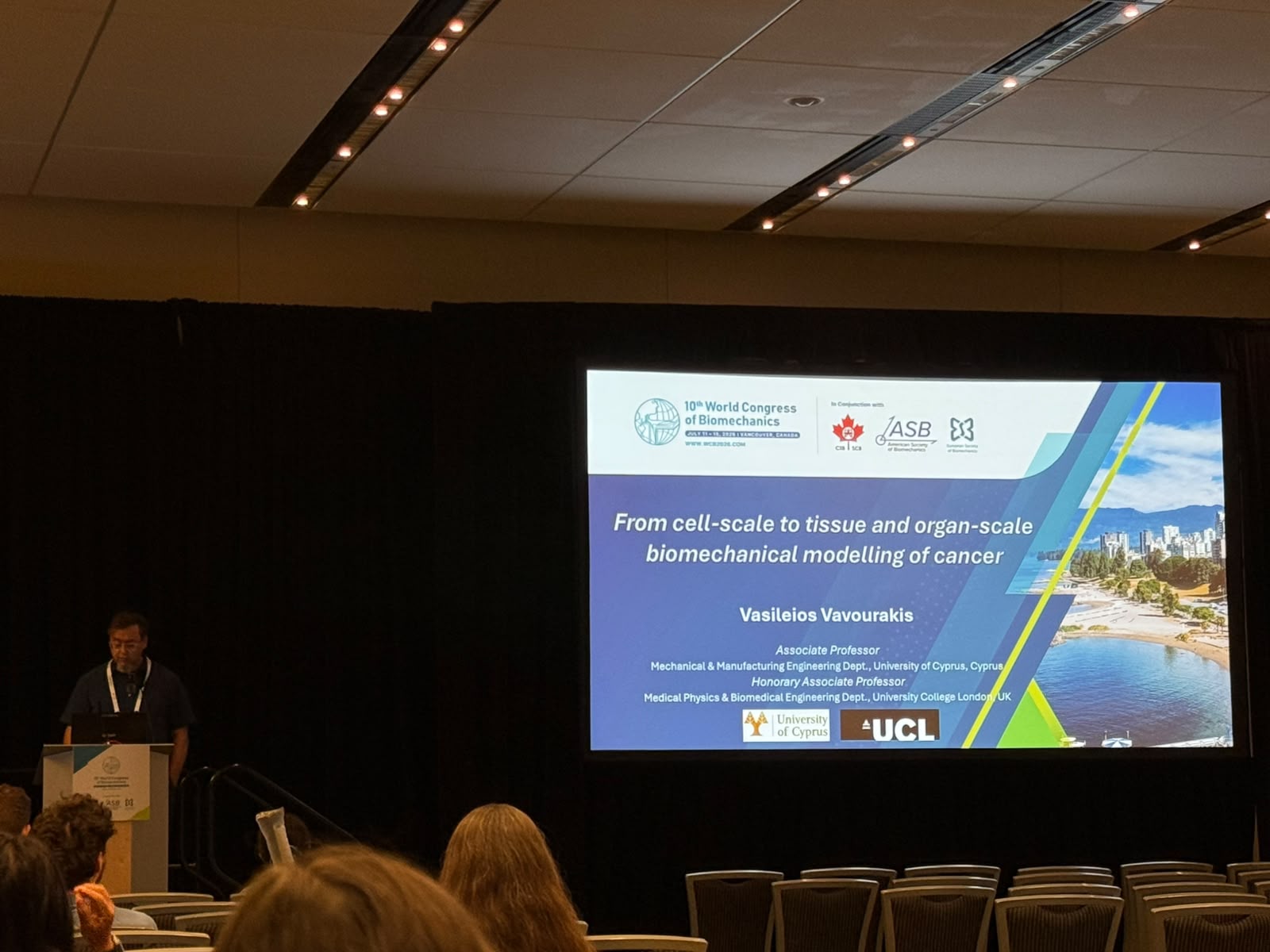
Dr Vasileios Vavourakis was invited to speak at the 10th World Congress of Biomechanics, the major international gathering held every four years, which brings together leading researchers from across the world. His keynote, “From cell-scale to tissue and organ-scale biomechanical modelling of cancer”, followed how cancer can be modelled at every level, from individual cells up to whole tissues and organs.
A case study: plasma and melanoma
One part of the keynote followed melanoma therapy from in vitro experiments to in silico modelling. It looked at melanoma cells treated with a helium atmospheric pressure plasma jet, alone and combined with the chemotherapy drug doxorubicin, and at how cell numbers changed over time. The case study builds on published experimental work (Gazeli et al., 2022, Applied Physics Letters).
From in vitro to in silico: the melanoma therapy case study.