Ignite Plasma at ICPIG 2025 INTERNATIONAL CONFERENCE ON PHENOMENA IN IONIZED GASES 36TH EDITION

The conference proved to be an incredibly rewarding experience, with our work receiving outstanding feedback from the plasma physics community, particularly highlighting:

✨ Our Key Innovations:

✅ Novel closed-loop systems for controlling excited species and power.
✅ Advanced 4-axis programmable translational stage system enabling more precise and efficient in vivo experiments
✅ User-friendly intuitive interface designed for seamless operation

The event was a fantastic opportunity to connect with fellow researchers and learn about cutting-edge developments in plasma physics and technology, including fascinating work on advanced diagnostics such as E-FISH and TALIF techniques that are pushing the boundaries of fundamental physicochemical research on plasma.

Thank you to all the brilliant minds we connected with at ICPIG 2025 – the exchange of ideas and positive reception of our work truly energizes our mission to advance plasma technology applications.

🔗 Excited for what’s next — collaborations, innovations, and further progress.


Follow us on #IgnitePLASMA


JULY 20TH/25TH – AIX EN PROVENCE, FRANCE

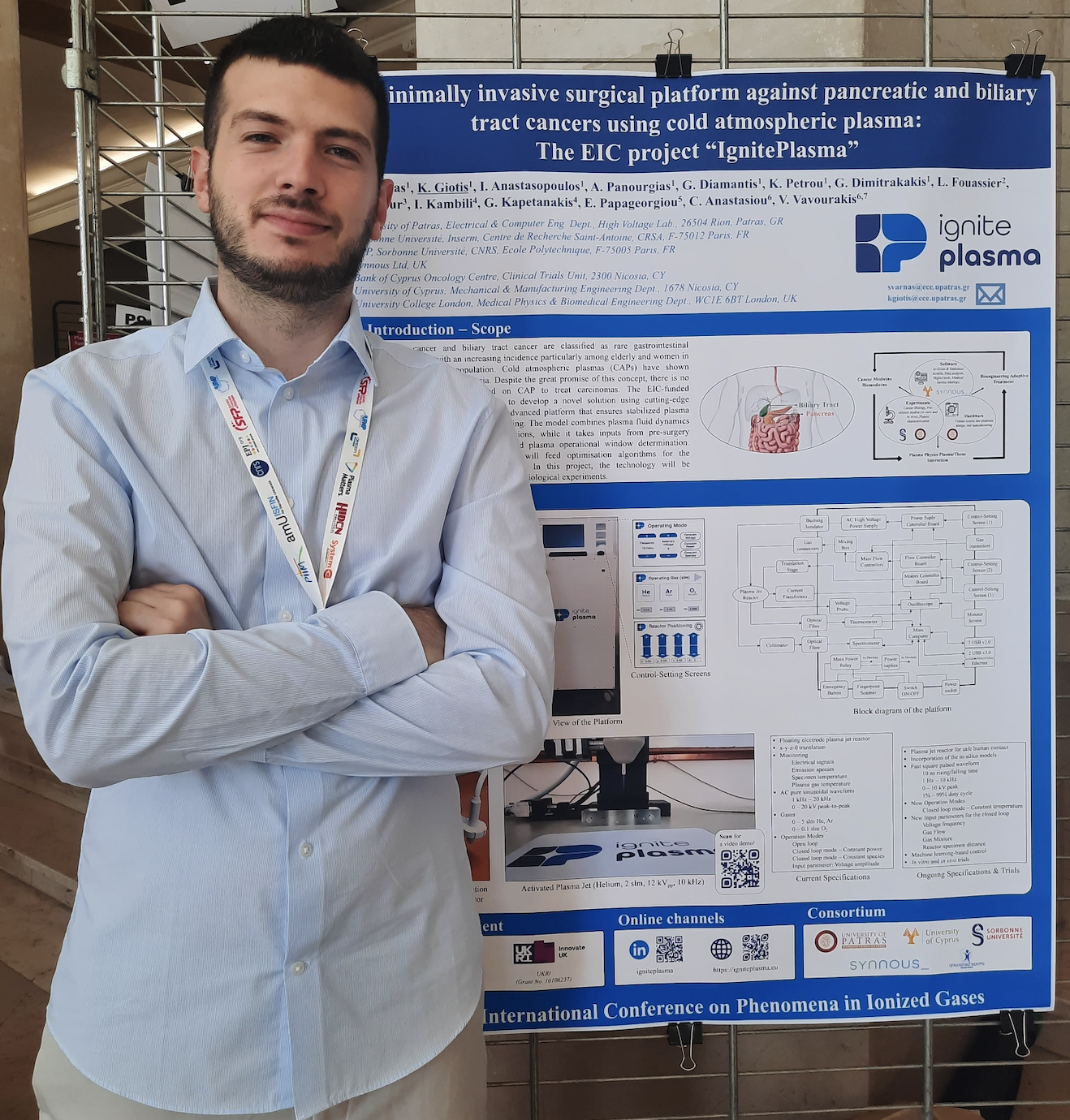
As part of the Ignite Plasma representation at the International Conference on Phenomena in Ionized Gases, ICPIG 2025, Konstantinos Giotis presented our latest progress on  our innovative platform development.

Konstantinos  is a valuable team member of our consortium partner ECE, University of Patras and, after of more than a year’s hard work, the team is proud to showcase their achievements.


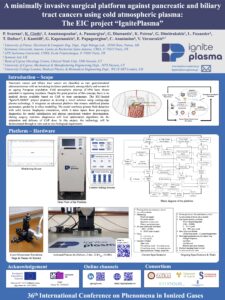
Poster ICPIG 2025


More information can be found  here 

The conference proved to be an incredibly rewarding experience, with our work receiving outstanding feedback from the plasma physics community, particularly highlighting:

✨ Our Key Innovations:

✅ Novel closed-loop systems for controlling excited species and power.
✅ Advanced 4-axis programmable translational stage system enabling more precise and efficient in vivo experiments
✅ User-friendly intuitive interface designed for seamless operation

The event was a fantastic opportunity to connect with fellow researchers and learn about cutting-edge developments in plasma physics and technology, including fascinating work on advanced diagnostics such as E-FISH and TALIF techniques that are pushing the boundaries of fundamental physicochemical research on plasma.

Thank you to all the brilliant minds we connected with at ICPIG 2025 – the exchange of ideas and positive reception of our work truly energizes our mission to advance plasma technology applications.

🔗 Excited for what’s next — collaborations, innovations, and further progress.


Follow us on #IgnitePLASMA

Ignite Plasma Presents Research COST ACTION PLASTHER FINAL MEETING

Research Objectives

To address this challenge, the research focuses on identifying the RONS that can penetrate biological barriers and determining the physical parameters able to modulate them. The team is working to optimize factors such as gas flow rate and electric field intensity using a conventional double ring-electrodes plasma jet supplied with helium at 1 L/min and applying nanopulse high-voltage parameters of 0-10 kV, 0-30 kHz, and 10%.

Moving Forward

This presentation at the Plaster Cost Action meeting represents another step in Ignite Plasma’s research into plasma-based cancer therapies. The collaboration with  Laboratory of Plasma Physics, Sorbonne University and Inserm, Centre de Recherche Saint-Antoine in Paris continues to advance our understanding in this field of medical research.


For more information about Ignite Plasma’s research initiatives and partnerships, please contact us or Follow us: #IgnitePlasma

Jun 17 – 20 2025  Barcelona, Spain

Ignite Plasma participated in the Plaster Cost Action meeting in June 2025, where our consortium partner Sorbonne University represented our research in cold atmospheric plasma therapy.

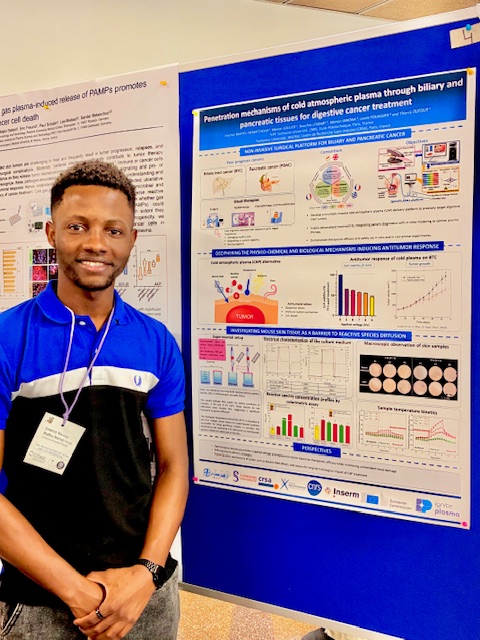
Emerick Biaffeu, a team member from Sorbonne University’s Laboratory of Plasma Physics in France, presented his team’s research on behalf of Ignite Plasma, focusing on the therapeutic potential of cold atmospheric plasma (CAP) for treating challenging cancer types.

Research Focus

The presentation outlined CAP as a promising therapeutic approach for patients suffering from cholangiocarcinoma (CCA – cancer of the biliary tract) and pancreatic ductal adenocarcinoma (PDAC) inducing selective cytotoxic effects. These effects can be mediated by different properties of CAP, e.g. reactive oxygen and nitrogen species (RONS) and electric field.

 The research has shown CAP’s anti tumor efficacy through tumor growth regression in murine models carrying subcutaneous tumors. However, the team recognizes that in patient situations, epithelial tissue may influence the penetration of plasma-generated species, potentially reducing treatment efficacy.


Poster A Plaster COST Action Meeting


More information can be found here
 

Research Objectives

To address this challenge, the research focuses on identifying the RONS that can penetrate biological barriers and determining the physical parameters able to modulate them. The team is working to optimize factors such as gas flow rate and electric field intensity using a conventional double ring-electrodes plasma jet supplied with helium at 1 L/min and applying nanopulse high-voltage parameters of 0-10 kV, 0-30 kHz, and 10%.

Moving Forward

This presentation at the Plaster Cost Action meeting represents another step in Ignite Plasma’s research into plasma-based cancer therapies. The collaboration with  Laboratory of Plasma Physics, Sorbonne University and Inserm, Centre de Recherche Saint-Antoine in Paris continues to advance our understanding in this field of medical research.


For more information about Ignite Plasma’s research initiatives and partnerships, please contact us or Follow us: #IgnitePlasma