Presenting IgnitePLASMA research at the French liver congress 99th Scientific Meeting of the French Association for the Study of the Liver (AFEF)

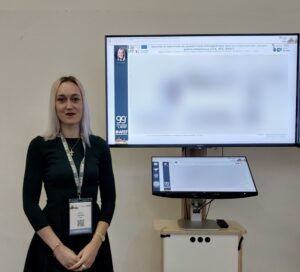
The congress brought together clinicians, researchers and industry representatives working on liver diseases, with particular attention to the links between basic research and clinical practice. Marion’s poster was displayed electronically, and she discussed the work with attendees and exchanged ideas with other participants.


🔗 AFEF 2026 congress 

Acknowledgement:

The project IgnitePLASMA is funded by the European Union (Call: HORIZON-EIC-2023-PATHFINDER OPEN-01; grant number: 101129853). UK participants in Horizon Europe Project ‘A minimally Invasive surgical platform aGainst paNcreatIc and biliary Tract cancErs using cold atmospheric PLASMA’ are supported by UKRI grant numbers 10106237 to Synnous Limited.

Disclaimer:

Funded by the European Union. Views and opinions expressed are however those of the author(s) only and do not necessarily reflect those of the European Union or the European Innovation Council and SMEs Executive Agency (EISMEA). Neither the European Union nor the granting authority can be held responsible for them.

Strasbourg, 7-9 October 2026


Marion Janona (NABI UMR 8175 / U1334) presented a poster titled “Innocuity and selectivity of cold atmospheric plasma in digestive cancers” at the AFEF congress.

The research work extends to address mainly three cancer  types: cholangiocarcinoma (bile duct cancer), hepatocellular carcinoma (liver cancer) and pancreatic ductal adenocarcinoma (pancreatic cancer). Innocuity concerns whether a treatment spares healthy cells, and selectivity whether it acts on cancer cells. Both matter for IgnitePLASMA, which is developing a minimally invasive surgical platform using cold atmospheric pressure plasma (CAPP) against pancreatic and biliary tract cancers.

Marion Janona is presenting IgnitePLASMA research at the French liver congress

   Read the post on LinkedIn

The congress brought together clinicians, researchers and industry representatives working on liver diseases, with particular attention to the links between basic research and clinical practice. Marion’s poster was displayed electronically, and she discussed the work with attendees and exchanged ideas with other participants.


🔗 AFEF 2026 congress 

Acknowledgement:

The project IgnitePLASMA is funded by the European Union (Call: HORIZON-EIC-2023-PATHFINDER OPEN-01; grant number: 101129853). UK participants in Horizon Europe Project ‘A minimally Invasive surgical platform aGainst paNcreatIc and biliary Tract cancErs using cold atmospheric PLASMA’ are supported by UKRI grant numbers 10106237 to Synnous Limited.

Disclaimer:

Funded by the European Union. Views and opinions expressed are however those of the author(s) only and do not necessarily reflect those of the European Union or the European Innovation Council and SMEs Executive Agency (EISMEA). Neither the European Union nor the granting authority can be held responsible for them.

IgnitePLASMA AT THE WORLD CONGRESS OF BIOMECHANICS 2026 From the lab bench to the computer: modelling how cancer responds to treatment

Work from across the team
Dr Vavourakis also presented work by his PhD student, Oliver Santos Lopes, on in silico modelling of biocompatible scaffolds, and a poster, led by his postdoctoral researcher Dr Eleftherios Ioannou, on brain cancer metastasis.

✨ Takeaways
✅ Presents computational modelling of plasma-based cancer treatment to the wider biomechanics community
✅ Raises the profile of the coordinator and the group’s cancer-modelling research on a major international stage
✅ Showcases work from across the team, including PhD and postdoctoral researchers

Acknowledgements
IgnitePLASMA is funded by the European Innovation Council under the Pathfinder Open programme (Grant Agreement No. 101129853) and UKRI (Grant Agreement No. 10106237).

11–15 July 2026 – Vancouver, Canada

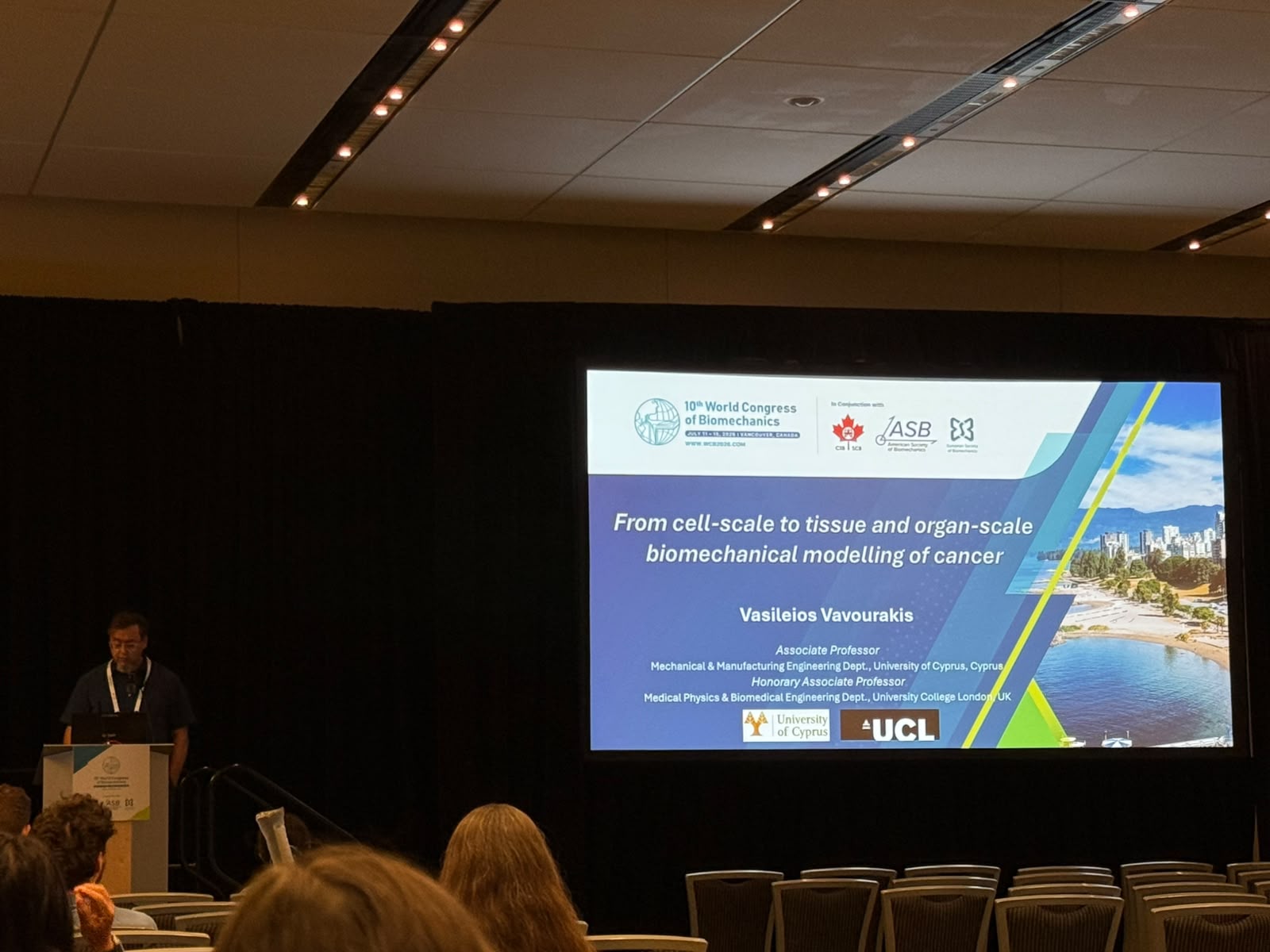
Before a treatment reaches a patient, researchers need to understand how cancer cells respond to it, and that is slow and costly to test experimentally alone. Computer-based (“in silico”) modelling offers a way to explore those responses more systematically, and it was the focus of a keynote lecture given in Vancouver this July by IgnitePLASMA’s coordinator.

Dr Vasileios Vavourakis was invited to speak at the 10th World Congress of Biomechanics, the major international gathering held every four years, which brings together leading researchers from across the world. His keynote, “From cell-scale to tissue and organ-scale biomechanical modelling of cancer”, followed how cancer can be modelled at every level, from individual cells up to whole tissues and organs.

A case study: plasma and melanoma

One part of the keynote followed melanoma therapy from in vitro experiments to in silico modelling. It looked at melanoma cells treated with a helium atmospheric pressure plasma jet, alone and combined with the chemotherapy drug doxorubicin, and at how cell numbers changed over time. The case study builds on published experimental work (Gazeli et al., 2022, Applied Physics Letters).

From in vitro to in silico: the melanoma therapy case study.

Dr Vasileios Vavourakis presenting a slide on in vitro to in silico melanoma therapy using an atmospheric pressure plasma jet, at the World Congress of Biomechanics 2026, Vancouver.


Work from across the team
Dr Vavourakis also presented work by his PhD student, Oliver Santos Lopes, on in silico modelling of biocompatible scaffolds, and a poster, led by his postdoctoral researcher Dr Eleftherios Ioannou, on brain cancer metastasis.

✨ Takeaways
✅ Presents computational modelling of plasma-based cancer treatment to the wider biomechanics community
✅ Raises the profile of the coordinator and the group’s cancer-modelling research on a major international stage
✅ Showcases work from across the team, including PhD and postdoctoral researchers

Acknowledgements
IgnitePLASMA is funded by the European Innovation Council under the Pathfinder Open programme (Grant Agreement No. 101129853) and UKRI (Grant Agreement No. 10106237).

IGNITE PLASMA AT ESCAMPIG 2026 27TH EUROPHYSICS CONFERENCE ON THE ATOMIC AND MOLECULAR PHYSICS OF IONIZED GASES

The framework was benchmarked on two atmospheric-pressure configurations: a pin-to-plate discharge in air and a helium plasma jet interacting with a dielectric target. Comparison against the commercial solver COMSOL shows strong agreement.

✨ What captionFOAM offers:

✅ A detailed chemistry model resolving electrons, ions, metastables and excited species, with semi-implicit coupling of the Poisson equation for the electric field
✅ Automated coupling to the BOLSIG+ Boltzmann solver and the LXCat database, generating OpenFOAM-compatible lookup tables and removing manual preparation of kinetic data
✅ Complex geometries and parallel execution on High Performance Computing systems, taking advantage of OpenFOAM’s capabilities
✅ A modular open-source architecture in which governing equations, chemistry models, boundary conditions and discretisation schemes can be extended by the user

Next steps include more complex chemistry, the effects of turbulent gas mixing, operation in different voltage waveforms, and the introduction of biological targets.


Acknowledgements

This work was partially funded by the European Union’s Horizon 2020 research and innovation programme under the Marie Skłodowska-Curie Action (Grant Agreement 101034403), and the Horizon-EIC-2023 Pathfinder Open (Grant Agreement 101129853) and UKRI (Grant Agreement 10106237).


Follow us on #IgnitePLASMA

The conference abstract is available on our Publications page

JULY 7TH/11TH – FUNCHAL, MADEIRA, PORTUGAL

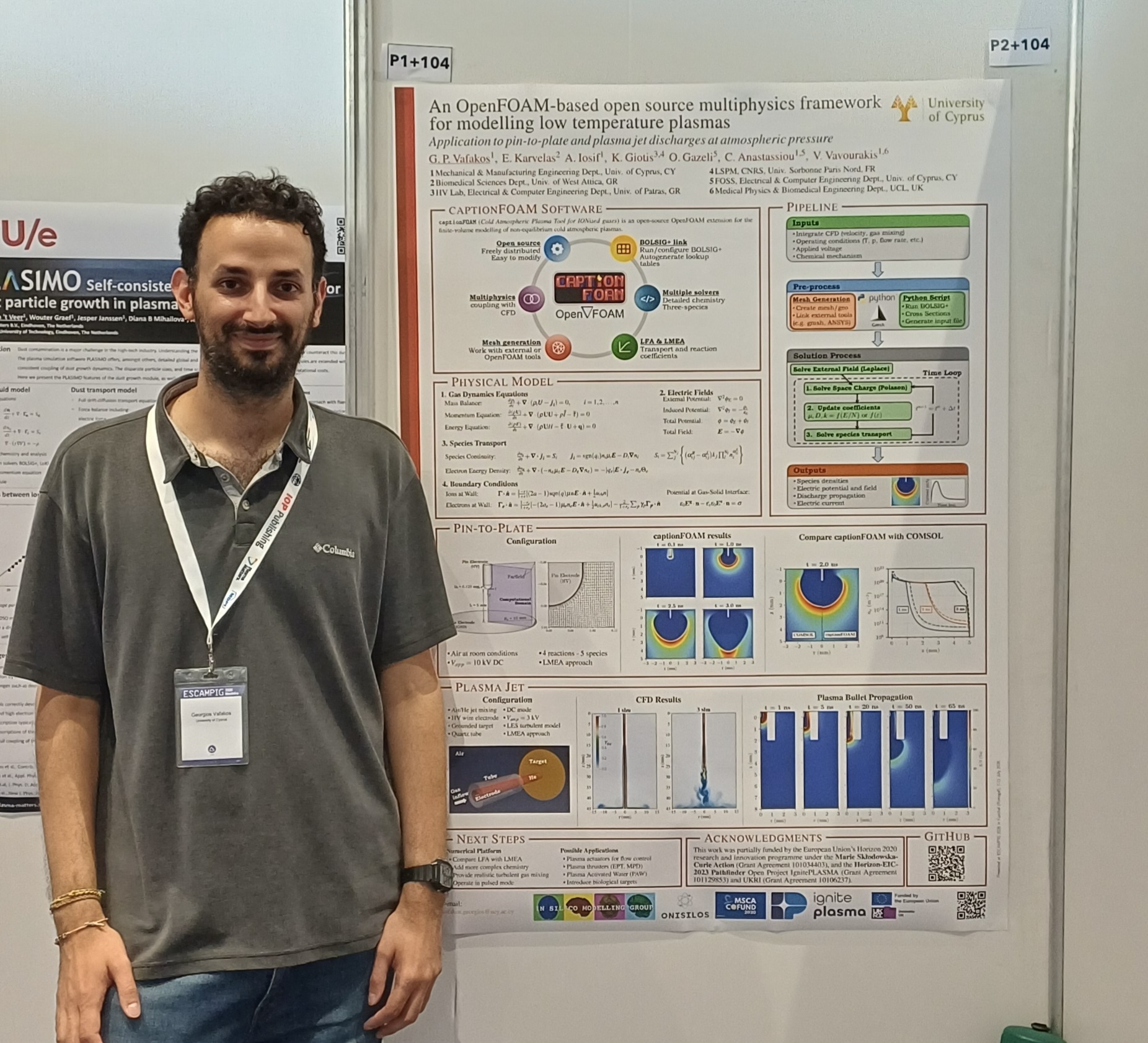
At ESCAMPIG 2026, George Vafakos presented a poster on captionFOAM, an open-source framework for modelling low temperature cold atmospheric plasmas. George is a Postdoctoral Researcher (MSCA COFUND Fellow) at our coordinating partner, the University of Cyprus, and a member of the In Silico Modelling Group.

Simulating a cold atmospheric pressure plasma discharge means resolving gas flow, plasma chemistry and electric fields together, as a single coupled problem — and doing so in geometries that resemble a real device rather than an idealised test case.

captionFOAM (Cold Atmospheric Plasma Tool for IONised gases) is an open-source extension of the OpenFOAM finite-volume library, developed for the modelling of non-equilibrium cold atmospheric plasmas. Because it sits inside OpenFOAM, the plasma equations can couple directly to the fluid dynamics and heat transport solvers already available there, and the model remains open-source for anyone to freely inspect, modify and reuse.

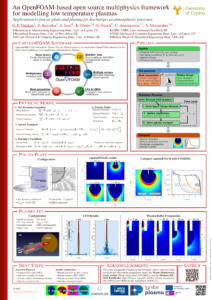
Poster ESCAMPIG 2026

Conference poster: An OpenFOAM-based open source multiphysics framework for modelling low temperature plasmas, ESCAMPIG 2026.


The framework was benchmarked on two atmospheric-pressure configurations: a pin-to-plate discharge in air and a helium plasma jet interacting with a dielectric target. Comparison against the commercial solver COMSOL shows strong agreement.

✨ What captionFOAM offers:

✅ A detailed chemistry model resolving electrons, ions, metastables and excited species, with semi-implicit coupling of the Poisson equation for the electric field
✅ Automated coupling to the BOLSIG+ Boltzmann solver and the LXCat database, generating OpenFOAM-compatible lookup tables and removing manual preparation of kinetic data
✅ Complex geometries and parallel execution on High Performance Computing systems, taking advantage of OpenFOAM’s capabilities
✅ A modular open-source architecture in which governing equations, chemistry models, boundary conditions and discretisation schemes can be extended by the user

Next steps include more complex chemistry, the effects of turbulent gas mixing, operation in different voltage waveforms, and the introduction of biological targets.


Acknowledgements

This work was partially funded by the European Union’s Horizon 2020 research and innovation programme under the Marie Skłodowska-Curie Action (Grant Agreement 101034403), and the Horizon-EIC-2023 Pathfinder Open (Grant Agreement 101129853) and UKRI (Grant Agreement 10106237).


Follow us on #IgnitePLASMA

The conference abstract is available on our Publications page

Webinar | From Concept to Prototype: The Cold Atmospheric Pressure Plasma Platform Developed for Minimally Invasive Cancer Treatment

WHEN

29 September 2026 — 17:00 EEST | 10:00 EDT

Approximately 50–60 minutes, including live Q&A.

This session is designed for researchers, biomedical engineers and clinicians with an interest in plasma medicine, as well as medtech innovators and stakeholders in the EIC ecosystem curious about plasma medicine and new technologies in cancer treatment.

IgnitePLASMA is funded by the European Innovation Council (EIC) under the Pathfinder Open programme (Grant Agreement No. 101129853) and UKRI (Grant Agreement No. 10106237).


Disclaimer:

By registering, you agree that Synnous Ltd may process the details you provide in order to administer this webinar and to report attendance figures to the European Innovation Council and UKRI, as required under the IgnitePLASMA grant agreements.This section will be recorded for internal project purposes. Attendee cameras and microphones remain off throughout; however, the name you register with may be visible if you submit a question during the Q&A.

To ask how your data is handled, or to request its deletion, contact us via igniteplasma.eu.


Pancreatic and biliary tract cancers remain among the most difficult cancers to treat, with limited surgical options and survival rates that have changed little in decades. Cold atmospheric pressure plasma (CAPP) is emerging as a promising modality, offering selective cytotoxic effects on tumour cells while minimising damage to surrounding healthy tissue.

Within the EIC- and UKRI-funded IgnitePLASMA project, researchers at the University of Patras have been designing, building and characterising the CAPP hardware platform that will underpin a novel minimally invasive surgical tool targeting these two malignancies.

Dr. Panagiotis Svarnas, Professor, University of Patras, Greece, leading its design and development, will present the engineering journey: from design requirements and plasma source development — including sinusoidal and pulsed CAPP configurations — through to sensor integration and the adaptive treatment capabilities now being refined. A demonstration of the 4D programmable translation stage system will offer a concrete look at the platform in action.


SPEAKERS

Dr. Panagiotis Svarnas, Professor, University of Patras, GR

Dr Vasileios Vavourakis, Professor, University of Cyprus


Register here

WHEN

29 September 2026 — 17:00 EEST | 10:00 EDT

Approximately 50–60 minutes, including live Q&A.

This session is designed for researchers, biomedical engineers and clinicians with an interest in plasma medicine, as well as medtech innovators and stakeholders in the EIC ecosystem curious about plasma medicine and new technologies in cancer treatment.

IgnitePLASMA is funded by the European Innovation Council (EIC) under the Pathfinder Open programme (Grant Agreement No. 101129853) and UKRI (Grant Agreement No. 10106237).


Disclaimer:

By registering, you agree that Synnous Ltd may process the details you provide in order to administer this webinar and to report attendance figures to the European Innovation Council and UKRI, as required under the IgnitePLASMA grant agreements.This section will be recorded for internal project purposes. Attendee cameras and microphones remain off throughout; however, the name you register with may be visible if you submit a question during the Q&A.

To ask how your data is handled, or to request its deletion, contact us via igniteplasma.eu.


EIC Summit 2026

Venue

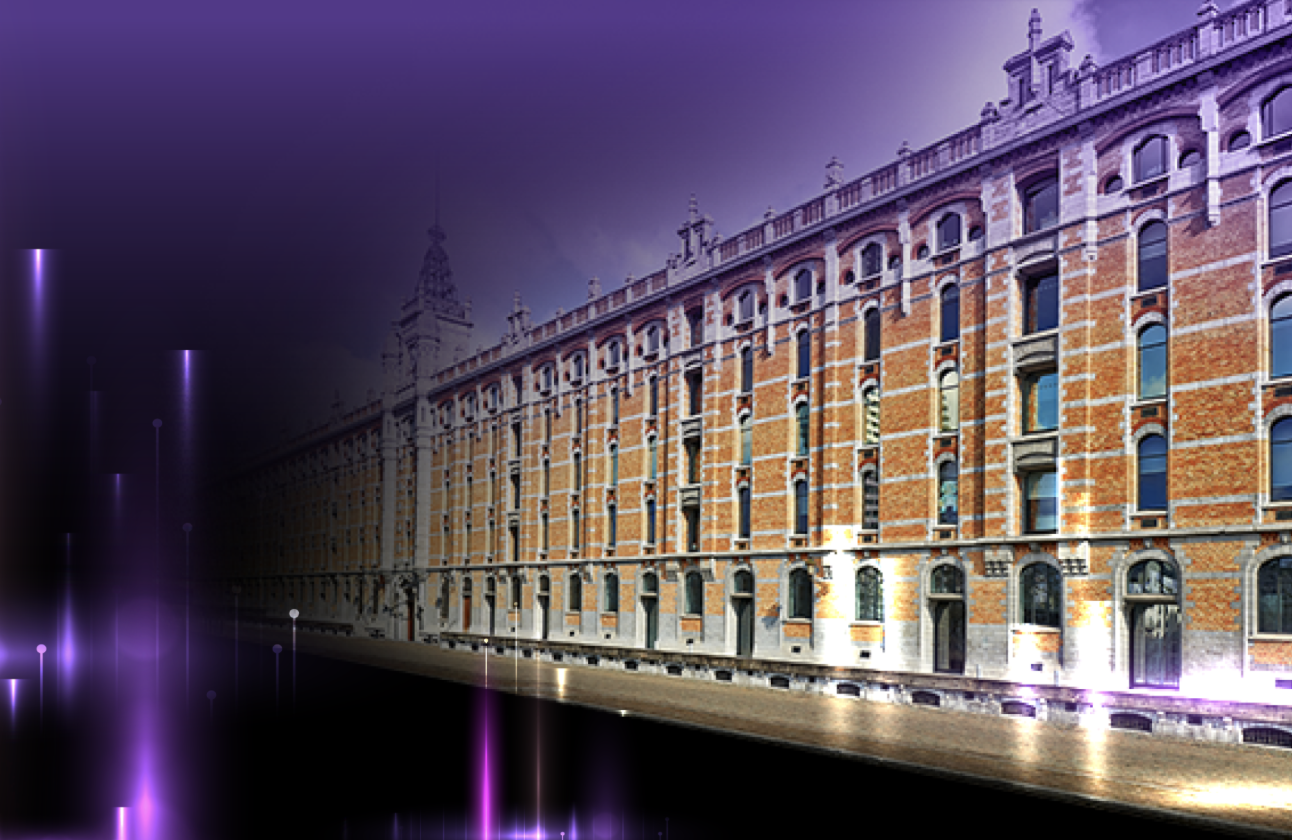
The EIC Summit 2026 will take place in the historical Tour & Taxis site on the Brussels Canal.


3-4 June 2026 – Brussels


Venue

The EIC Summit 2026 will take place in the historical Tour & Taxis site on the Brussels Canal.


Moving from lab to market: the EIC Tech to Market Programme

Want to learn more? Join the online Info Session on

11 March 2026, 11:00 – 12:30 (CET).


Applications to the EIC Entrepreneurial Trainings will open on a rolling basis starting from the day of the Info Session. Applications to EIC Venture Building Services will open at the beginning of each exploration cycle.

The Programme is open to all EIC Pathfinder and EIC Transition beneficiaries, EIC Transition Seal of Excellence holders, entities eligible for EIC Transition projects and Women TechEU awardees.

It combines two complementary services:

EIC Entrepreneurial Trainings, build the knowledge and commercial understanding needed to bring deep-tech innovations to the market.

EIC Venture Building Services, support selected EIC Pathfinder and EIC Transition teams in shaping, structuring and growing their ventures towards investment and early scale-up.

Together, these services help beneficiaries take their research beyond the lab and explore concrete pathways to market success.


11 March 2026 – Online Info Session


CALL | 27 FEBRUARY 2026

The European Innovation Council has launched the second edition of the EIC Tech to Market Programme, an EIC Business Acceleration Service designed to help deep-tech researchers and innovators move from breakthrough research to viable ventures.

The path from lab to venture is one of the most challenging stages in innovation. The EIC Tech to Market Programme gives you the skills, expert support, and ecosystem access needed to validate your idea, strengthen your team, and move from breakthrough research to an investable company. Across the EU, researchers are already stepping forward, turning frontier science into ventures with global ambition.


More information about the program can be found here


Want to learn more? Join the online Info Session on

11 March 2026, 11:00 – 12:30 (CET).


Applications to the EIC Entrepreneurial Trainings will open on a rolling basis starting from the day of the Info Session. Applications to EIC Venture Building Services will open at the beginning of each exploration cycle.

The Programme is open to all EIC Pathfinder and EIC Transition beneficiaries, EIC Transition Seal of Excellence holders, entities eligible for EIC Transition projects and Women TechEU awardees.

It combines two complementary services:

EIC Entrepreneurial Trainings, build the knowledge and commercial understanding needed to bring deep-tech innovations to the market.

EIC Venture Building Services, support selected EIC Pathfinder and EIC Transition teams in shaping, structuring and growing their ventures towards investment and early scale-up.

Together, these services help beneficiaries take their research beyond the lab and explore concrete pathways to market success.


EIC Info Day in Nicosia, Cyprus

Join us for the EIC Info Day in Cyprus on 18 February 2026, 14:00 – 18:00 (EET) at the Hilton Nicosia.


There will be two parallel sessions (see the programme below). Participants are required to select their preferred session upon registration.

Session Preference

During the info day, two parallel sessions will be offered: one track will focus on the EIC Accelerator, and the other will cover the EIC Pathfinder and EIC Transition funding schemes. Please choose the session you wish to attend.


Not sure which track would be the most relevant for your project? Please refer to the EIC webpage to discover more.


18 February 2026

The European Innovation Council (EIC) and the Research and Innovation Foundation (RIF), are organising an EIC Info Day taking place in Nicosia, Cyprus, on 18 February 2026, at the Hilton Nicosia.

The event will present the current EIC Work Programme, providing detailed information on the individual calls and highlighting funding opportunities available to potential applicants.


More information about the Programme can be found here

Join us for the EIC Info Day in Cyprus on 18 February 2026, 14:00 – 18:00 (EET) at the Hilton Nicosia.


There will be two parallel sessions (see the programme below). Participants are required to select their preferred session upon registration.

Session Preference

During the info day, two parallel sessions will be offered: one track will focus on the EIC Accelerator, and the other will cover the EIC Pathfinder and EIC Transition funding schemes. Please choose the session you wish to attend.


Not sure which track would be the most relevant for your project? Please refer to the EIC webpage to discover more.


ESCAMPIG 2026 – Europhysics Conference on the Atomic and Molecular Physics of Ionized Gases

Venue

ESCAMPIG consists of plenary, invited general lectures and topical lectures, poster sessions and workshops. All contributed papers (oral and poster) will be refereed by the International Scientific Committee, and only approved contributions will be published in the electronic book of contributed papers. The subject categories for the conference are as follows:

  1. Atomic and molecular processes in plasmas
  2. Transport phenomena, particle velocity distribution function
  3. Physical basis of plasma chemistry
  4. Plasma surface interaction (boundary layers, sheath, surface processes)
  5. Plasma diagnostics
  6. Plasma and discharges theory and simulation
  7. Self-organization in plasmas, dusty plasmas
  8. Upper atmospheric plasmas and space plasmas
  9. Low pressure plasma sources
  10. High pressure plasma sources
  11. Plasmas and gas flows
  12. Laser produced plasmas

The conference will be held at Madeira Congress Centre, located near the heart of Funchal, the capital of Madeira. The Congress Centre is part of a complex designed by the famous Brazilian architect Oscar Niemeyer.

More info can be found here

7-11 July 2026

Location: Funchal, Portugal

The ESCAMPIG (Europhysics Conference on Atomic and Molecular Physics of Ionized Gases) is an international biennial conference of the EPS (European Physical Society). The conference topics comprise basic and applied plasma research. The 27th ESCAMPIG will be organized by the Institute for Plasmas and Nuclear Fusion and the University of Madeira.

Venue

ESCAMPIG consists of plenary, invited general lectures and topical lectures, poster sessions and workshops. All contributed papers (oral and poster) will be refereed by the International Scientific Committee, and only approved contributions will be published in the electronic book of contributed papers. The subject categories for the conference are as follows:

  1. Atomic and molecular processes in plasmas
  2. Transport phenomena, particle velocity distribution function
  3. Physical basis of plasma chemistry
  4. Plasma surface interaction (boundary layers, sheath, surface processes)
  5. Plasma diagnostics
  6. Plasma and discharges theory and simulation
  7. Self-organization in plasmas, dusty plasmas
  8. Upper atmospheric plasmas and space plasmas
  9. Low pressure plasma sources
  10. High pressure plasma sources
  11. Plasmas and gas flows
  12. Laser produced plasmas

The conference will be held at Madeira Congress Centre, located near the heart of Funchal, the capital of Madeira. The Congress Centre is part of a complex designed by the famous Brazilian architect Oscar Niemeyer.

More info can be found here

10th World Congress of Biomechanics

European Society Of Biomechanics (ESB)

ESB is a scientific organization dedicated to the advancement of biomechanics in Europe. Established in 1976, the ESB brings together researchers, engineers, and clinicians from academia and industry to promote the study of biomechanics in various fields, including orthopedics, rehabilitation, sports science, tissue engineering, and medical devices. SB also supports young researchers with awards, travel grants, and mentoring programs.


Venue

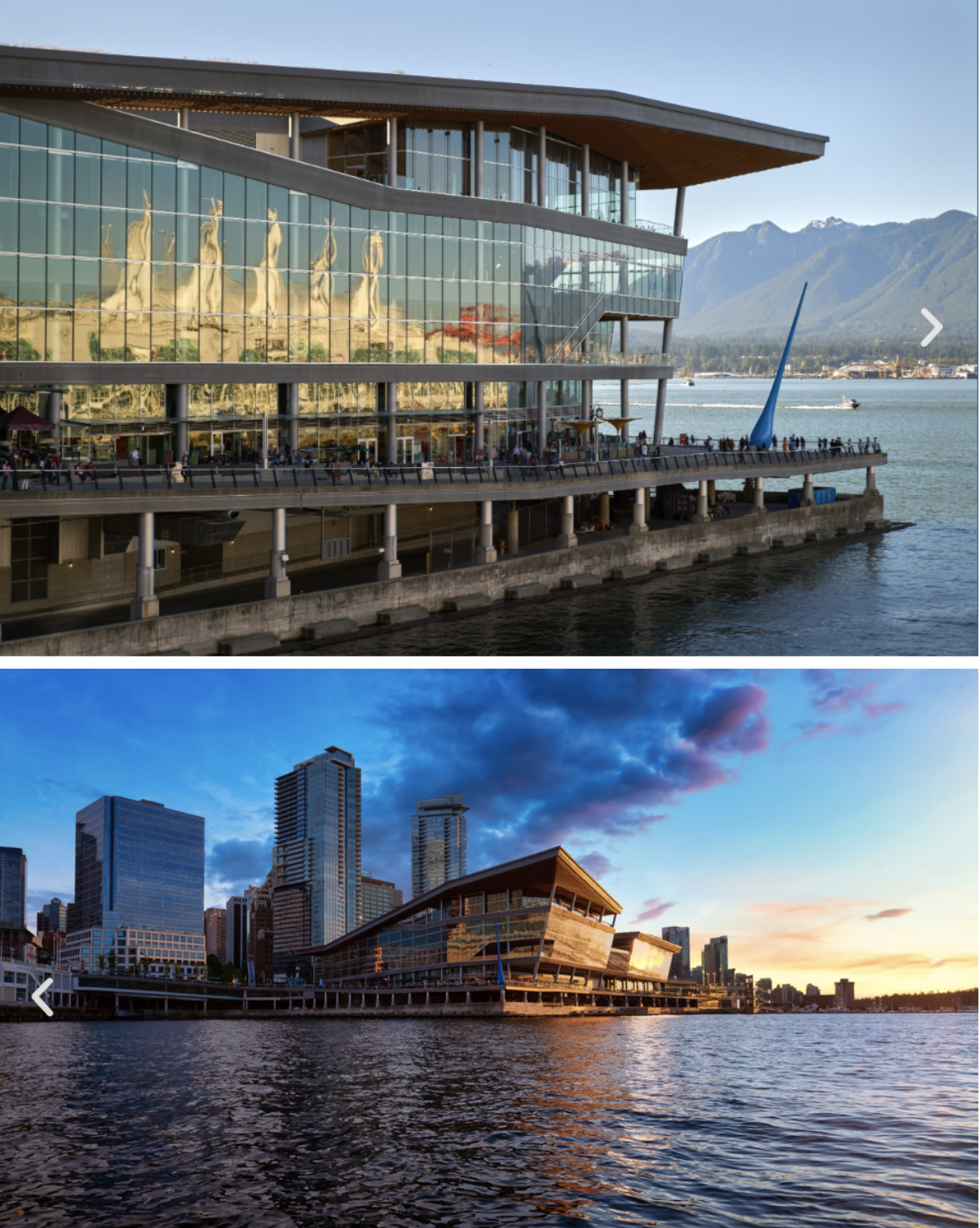
Vancouver Convention Centre

The Vancouver Convention Centre, located downtown with views of the North Shore Mountains and the Burrard Inlet, is one of the world’s top conference venues.  

This award-winning, eco-friendly facility offers breathtaking views, modern architecture, and cutting-edge amenities, providing delegates with an inspiring setting for conferences, events, and exhibitions. With its commitment to sustainability, including a living roof and a zero-waste policy, the Centre aligns with Vancouver’s values of environmental stewardship. From its spacious meeting rooms to its close proximity to world-class dining, accommodations, and attractions, the Vancouver Convention Centre ensures an exceptional experience for every visitor. 

11 – 15 July, 2026 – Vancouver, Canada

The 10th World Congress of Biomechanics is coming to vibrant Vancouver from July 11-15, 2026—and we can’t wait to welcome you. We are thrilled to bring you an unforgettable event that celebrates all that’s new, bold, and boundary-pushing in biomechanics. The 10th World Congress of Biomechanics will feature a rich scientific and social program bringing together our global research community. We are honored to announce that the 10th World Congress will serve as the 2026 meeting of our 3 principal partners: the American Society of Biomechanics (ASB), the Canadian Society of Biomechanics/Société Canadienne de Biomécanique (CSB/SCB), and the European Society of Biomechanics (ESB).  

In addition to the high quality and diverse spectrum of scientific tracks you have come to expect from the World Congress, we are striving to amplify contributions of researchers that are embracing emerging areas that we will announce more on as the planning progresses, but will undoubtedly include wearable sensors, artificial intelligence, regenerative medicine, novel devices, and much more. This Congress will be an immersive, hands-on experience in one of the most dynamic cities in the world. Expect workshops that spark creativity, discussions that challenge the status quo, and networking opportunities against the stunning backdrop of Vancouver’s mountains and ocean. 

Join us in continuing the tradition of excellence of more than two decades of World Congresses now past, and forging the next directions in your field. This is more than a Congress; it’s a chance to inspire, be inspired, and chart new directions. Vancouver is calling, and you won’t want to miss this incredible opportunity! 

WCB 2026 Host Societies

ASB is dedicated to advancing the field of biomechanics through research, education, and collaboration. Founded in 1977, ASB serves as a leading platform for scientists, engineers, clinicians, and industry professionals working in areas such as human movement, musculoskeletal mechanics, rehabilitation, sports science, and biomedical engineering. The society also supports student development, mentorship programs, and awards that recognize outstanding contributions to the field.

Canadian Society Of Biomechanics –
Société Canadienne De Biomécanique (CSB/SCB)

Established in 1973, the CSB/SCB is a multidisciplinary organization that promotes the study and application of biomechanics in Canada. With over 250 members worldwide, the society aims to enhance interdisciplinary communication among professionals such as therapists, physicians, engineers, physicists, mathematicians, biologists, sport researchers, and ergonomists. By fostering collaboration across these diverse fields, the CSB/SCB seeks to improve the quality of biomechanics research and its practical applications. CSB/SCB plays a pivotal role in advancing biomechanics research and facilitating the exchange of knowledge among professionals from diverse disciplines.


More info can be found here

European Society Of Biomechanics (ESB)

ESB is a scientific organization dedicated to the advancement of biomechanics in Europe. Established in 1976, the ESB brings together researchers, engineers, and clinicians from academia and industry to promote the study of biomechanics in various fields, including orthopedics, rehabilitation, sports science, tissue engineering, and medical devices. SB also supports young researchers with awards, travel grants, and mentoring programs.


Venue

Vancouver Convention Centre

The Vancouver Convention Centre, located downtown with views of the North Shore Mountains and the Burrard Inlet, is one of the world’s top conference venues.  

This award-winning, eco-friendly facility offers breathtaking views, modern architecture, and cutting-edge amenities, providing delegates with an inspiring setting for conferences, events, and exhibitions. With its commitment to sustainability, including a living roof and a zero-waste policy, the Centre aligns with Vancouver’s values of environmental stewardship. From its spacious meeting rooms to its close proximity to world-class dining, accommodations, and attractions, the Vancouver Convention Centre ensures an exceptional experience for every visitor. 

WCCM-ECCOMAS 2026

Congress Venue

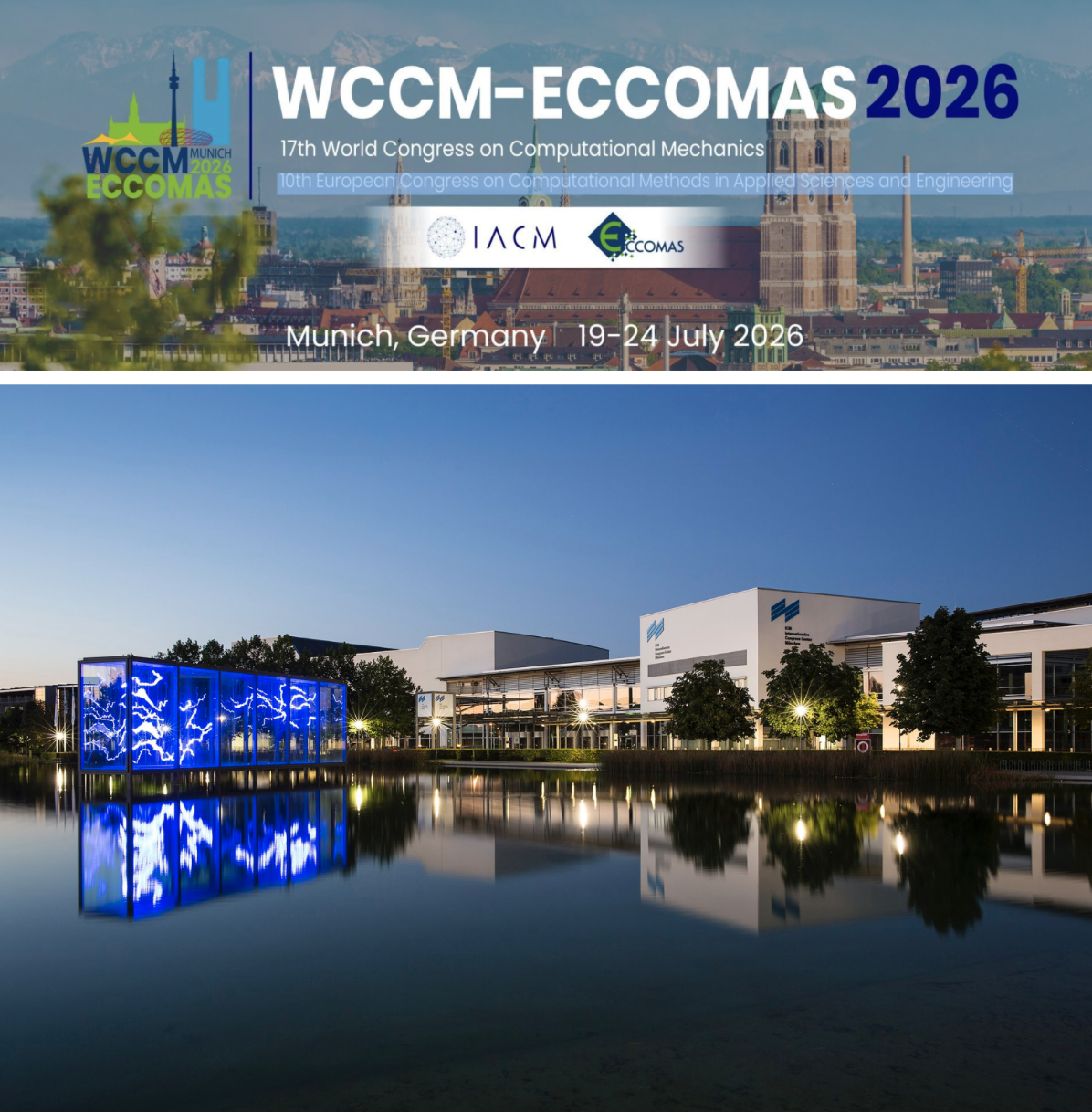
WCCM-ECCOMAS 2026 will be hosted at the ICM International Congress Center Messe München.


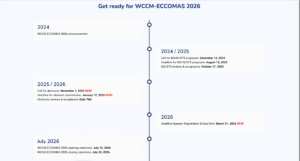
Important Dates

More info can found here

17th World Congress on Computational Mechanics

10th European Congress on Computational Methods in Applied Sciences and Engineering

19-24 July 2026 – Munich, Germany


WCCM-ECCOMAS 2026 is expected to be one of the largest congresses in the field of computational mechanics and computational methods in applied sciences and engineering. It is anticipated to attract a diverse and global audience from academia, government, and industry, encompassing all areas of engineering and science. Computational mechanics has become a cornerstone of modern scientific inquiry, driving solutions to some of the most advanced and complex challenges in engineering and beyond.

Special Technology Sessions (STS)

On initiative of the ECCOMAS Industry Interest Group, the WCCM-ECCOMAS Congress 2026 will have Special Technology Sessions (STS) on technologies and research especially of relevance for industrial applications. The STS will address advanced computational methods and tools needed for sustainable aviation, surface transport and other industry areas, as well as their validation and application. At the ECCOMAS Congresses since 1996, the industrial technology oriented STS have a long tradition, based on the fact, that the industry in Europe, especially in Aviation and Transport, had and still has a strong need for advanced computational methods in areas as fluid dynamics, structure mechanics, design optimisation and operations. With artificial intelligence (AI), machine learning and big data handling the challenges get another dimension for industry that needs to be addressed.

The STS will address advanced sustainable technologies for aviation, transport and related industry areas

Aviation, Surface Transport and related industries need to reduce their emissions and to play a driving role towards limiting global warming. Aviation and surface transport have the goal of climate neutrality by mid-century, which requires a significant increase in novel technologies and enhanced innovation.

At WCCM-ECCOMAS 2026, the STS will address the development and use of computational methods, their validation and application, all contributing to reducing emissions of aviation, surface transport and related industries. This includes innovative computational methods and design tools for all relevant technology areas reaching up to concepts of novel configurations and advanced propulsion systems.

As the WCCM-ECCOMAS Congress focuses on computational methods, the aim of the STS and their papers is to present novel computational and digitalized methods and tools (modelling, simulation, optimisation and control, artificial intelligence (AI), etc.) for the application in aviation, surface transport and related industries. The STS can also include the validation and technology demonstration by experiments and testing. In the view of high-performance computing and big data handling, the STS will also address the use of computational methods for innovative production and operation methods for the different transport means.


Congress Venue

WCCM-ECCOMAS 2026 will be hosted at the ICM International Congress Center Messe München.


Important Dates

More info can found here