IGNITE PLASMA AT ESCAMPIG 2026
27TH EUROPHYSICS CONFERENCE ON THE ATOMIC AND MOLECULAR PHYSICS OF IONIZED GASES
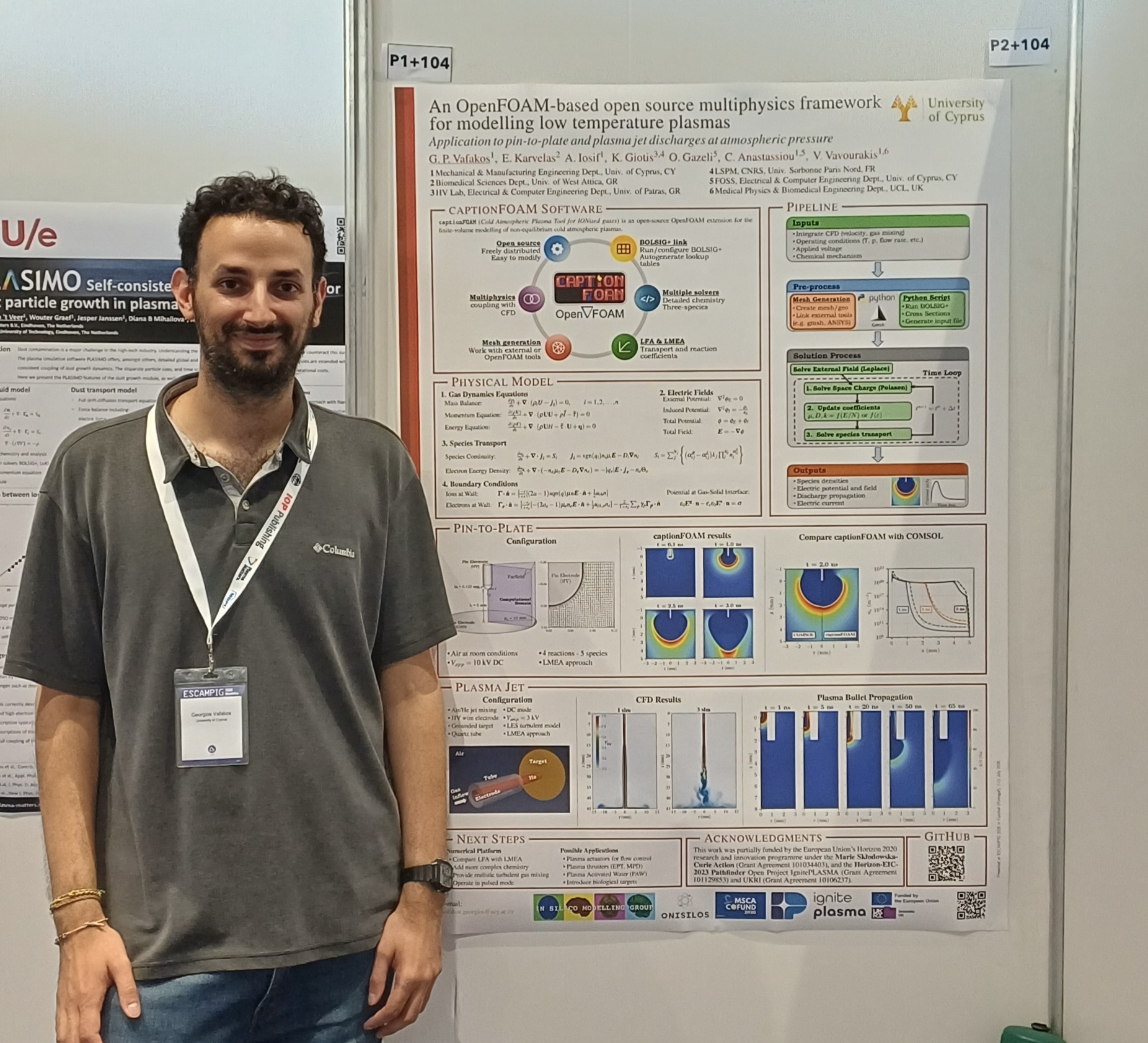
The framework was benchmarked on two atmospheric-pressure configurations: a pin-to-plate discharge in air and a helium plasma jet interacting with a dielectric target. Comparison against the commercial solver COMSOL shows strong agreement.
✨ What captionFOAM offers:
✅ A detailed chemistry model resolving electrons, ions, metastables and excited species, with semi-implicit coupling of the Poisson equation for the electric field
✅ Automated coupling to the BOLSIG+ Boltzmann solver and the LXCat database, generating OpenFOAM-compatible lookup tables and removing manual preparation of kinetic data
✅ Complex geometries and parallel execution on High Performance Computing systems, taking advantage of OpenFOAM’s capabilities
✅ A modular open-source architecture in which governing equations, chemistry models, boundary conditions and discretisation schemes can be extended by the user
Next steps include more complex chemistry, the effects of turbulent gas mixing, operation in different voltage waveforms, and the introduction of biological targets.
Acknowledgements
This work was partially funded by the European Union’s Horizon 2020 research and innovation programme under the Marie Skłodowska-Curie Action (Grant Agreement 101034403), and the Horizon-EIC-2023 Pathfinder Open (Grant Agreement 101129853) and UKRI (Grant Agreement 10106237).
Follow us on #IgnitePLASMA
The conference abstract is available on our Publications page
JULY 7TH/11TH – FUNCHAL, MADEIRA, PORTUGAL
At ESCAMPIG 2026, George Vafakos presented a poster on captionFOAM, an open-source framework for modelling low temperature cold atmospheric plasmas. George is a Postdoctoral Researcher (MSCA COFUND Fellow) at our coordinating partner, the University of Cyprus, and a member of the In Silico Modelling Group.
Simulating a cold atmospheric pressure plasma discharge means resolving gas flow, plasma chemistry and electric fields together, as a single coupled problem — and doing so in geometries that resemble a real device rather than an idealised test case.
captionFOAM (Cold Atmospheric Plasma Tool for IONised gases) is an open-source extension of the OpenFOAM finite-volume library, developed for the modelling of non-equilibrium cold atmospheric plasmas. Because it sits inside OpenFOAM, the plasma equations can couple directly to the fluid dynamics and heat transport solvers already available there, and the model remains open-source for anyone to freely inspect, modify and reuse.
Poster ESCAMPIG 2026
The framework was benchmarked on two atmospheric-pressure configurations: a pin-to-plate discharge in air and a helium plasma jet interacting with a dielectric target. Comparison against the commercial solver COMSOL shows strong agreement.
✨ What captionFOAM offers:
✅ A detailed chemistry model resolving electrons, ions, metastables and excited species, with semi-implicit coupling of the Poisson equation for the electric field
✅ Automated coupling to the BOLSIG+ Boltzmann solver and the LXCat database, generating OpenFOAM-compatible lookup tables and removing manual preparation of kinetic data
✅ Complex geometries and parallel execution on High Performance Computing systems, taking advantage of OpenFOAM’s capabilities
✅ A modular open-source architecture in which governing equations, chemistry models, boundary conditions and discretisation schemes can be extended by the user
Next steps include more complex chemistry, the effects of turbulent gas mixing, operation in different voltage waveforms, and the introduction of biological targets.
Acknowledgements
This work was partially funded by the European Union’s Horizon 2020 research and innovation programme under the Marie Skłodowska-Curie Action (Grant Agreement 101034403), and the Horizon-EIC-2023 Pathfinder Open (Grant Agreement 101129853) and UKRI (Grant Agreement 10106237).
Follow us on #IgnitePLASMA
The conference abstract is available on our Publications page